

 EN
EN
Replacing Hunger with Flowers: A New Model of Social Work for Homeless People in Brazil
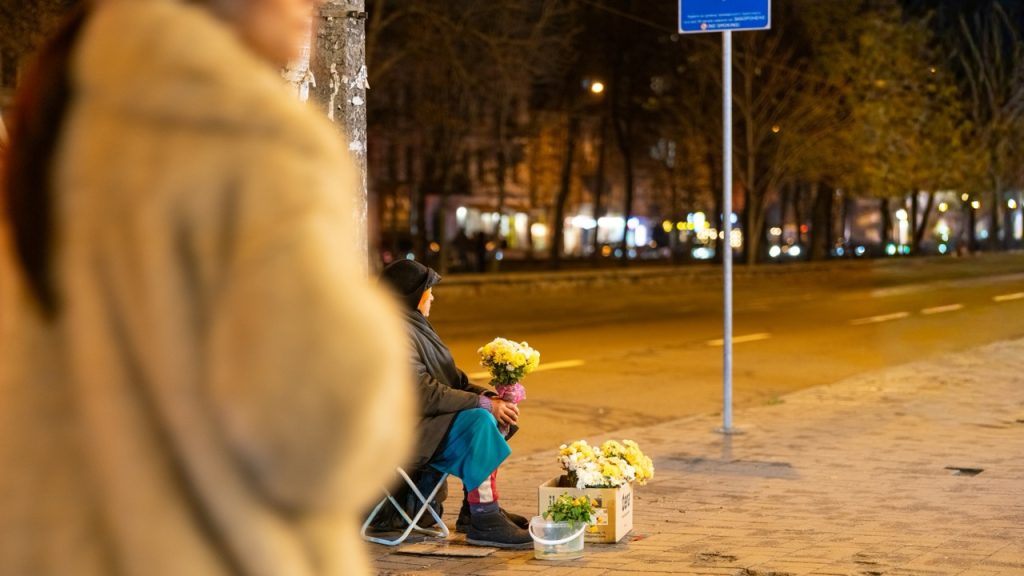
In Porto Alegre, the Troque a Fome por Flor initiative empowers homeless people through flower sales and financial literacy. This innovative social work model in Brazil replaces hunger with dignity, offering a path to independence through work.
When Lorenzo Dovera neared the completion of his university studies in public and social administration in 2021, his thesis project uncovered more of how the city of Porto Alegre (Brazil) lacked policy to help people experiencing homelessness to gain income.
“What I noticed a lot was that they would leave the shelters at 6:00 AM [during the cold] and they would spend the whole day at the shelter door waiting to go back in”, he said.
He noted that his observations also happened within the tailing end of the COVID-19 pandemic. “Many people were unemployed, many people were on the streets, [and] many people had those signs, you know?”
The signs read: Tô com fome. Me ajuda. (“I’m hungry. Help me.”)
“And that’s where the idea came from… Why not replace those signs with something that, you know, helps them in a more dignified way?”.
Troque a Fome por Flor: The Initiative That Changes Lives
From that idea, the name for his initiative was born: Troque a Fome por Flor (Swap Hunger for a Flower, in Portuguese). The vendors are called “florists,” and since the first attempt happened around Mother’s Day, Lorenzo thought it was a good item to sell. As the project grew, florists now also sell herb seedlings on the streets of downtown Porto Alegre. They are packaged in upcycled tetra pack (plastic-coated paper carton) milk bottles.
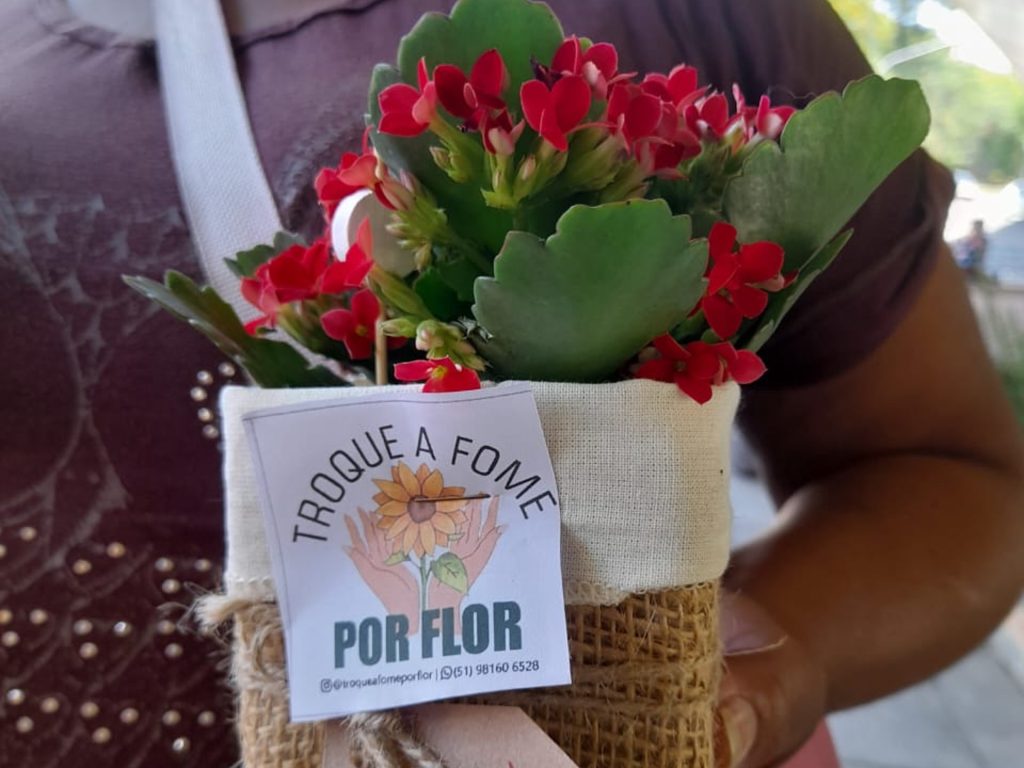
Every box has 15 boxes with seedlings. As the project evolved and more florists joined, Lorenzo introduced the aspect of financial education. “It was this awareness,” he explained “of, like, ‘Oh, but I can’t spend everything I earn here selling these seedlings. I have to save a part [of the money] to give to Lorenzo.’”
They were required to sell the plant pot for a minimum of R$5. Florists could then purchase four new boxes of cachepots for R$1 to sell again the next week.
“The idea is to create this kind of progression with them, right? Our motto is trust. I’m trusting you to come next Saturday and bring me R$1,” Lorenzo explained. He said that he often jokes with the florists that “if you don’t bring R$1, you’ll end up bankrupting the business here.” He also tells them “it’s good to have this responsibility to save [some money]”.
Building Trust and Responsibility Through Social Entrepreneurship
Lorenzo said leading the Troque a Fome por Flor collective presents many daily challenges, from finding collaborators who commit and teach financial literacy to the florists. Some people help through money donations. Others help through collecting, cleaning, and generously giving milk bottles to transform into cachepots.
“That’s what’s beautiful,” he said, “This chain… I see it as a fraternal chain, right? Of affection, of love, of respect.”
But his main challenge is having a set place to meet with the florists every Saturday. Through his thesis project, Lorenzo identified the biggest concentration of people experiencing homelessness in downtown Porto Alegre, so that was his target area.
Every Saturday at 11 a.m., under the city’s Imperatriz Leopoldina Viaduct, Lorenzo meets with the florists. While around 12 of them are recurring ones, he welcomes between 30 to 40 new florists every month.
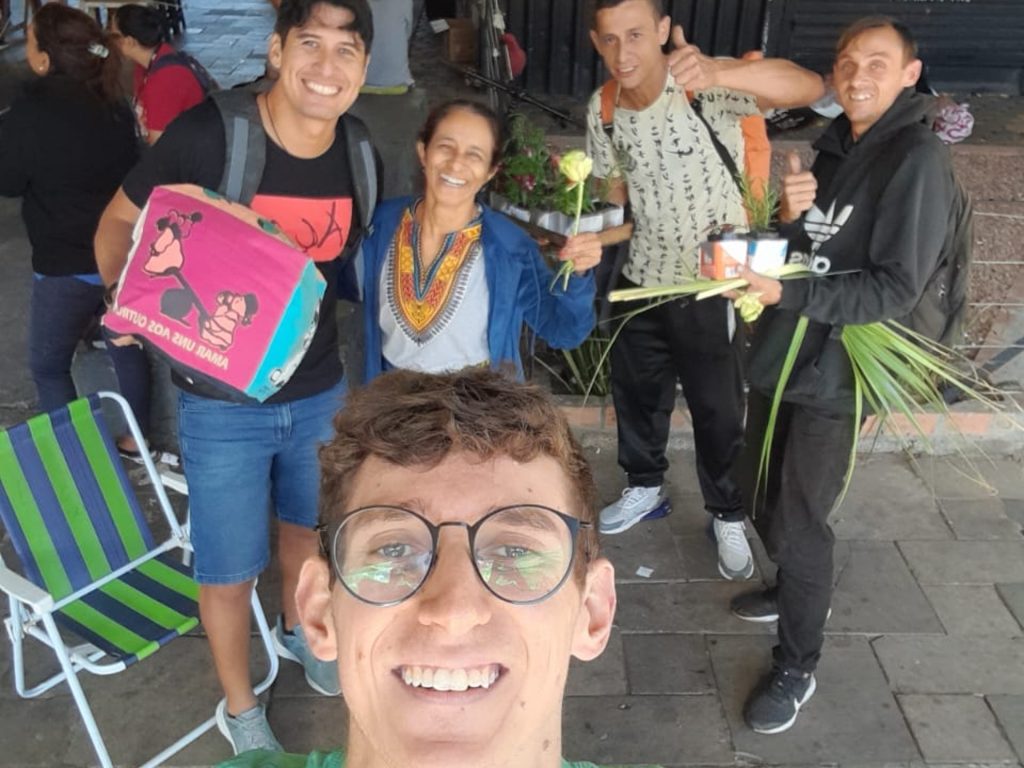
“It’s so beautiful because [for me], it’s a world of things, right? Because besides my project, there are barbers [and] there’s an NGO that distributes food.” Some weeks another NGO dedicated to offering medical attention to people experiencing homelessness joins, as well as another group to help with their animals.
“There are also [people dressed up as] clowns who are there making a mess under the overpass,” Lorenzo added. “So, there’s a little bit of everything, you know? I see that there, at that moment, it’s beautiful to see, because they are… Each one has their own pain, each one has their own anguish [with] not having a place to live, not having anything to eat the next day, you know? And it’s at that moment… it seems like an atypical world for them.”
What We Can Learn from Homelessness in Brazil
Lorenzo also said that the biggest lesson for him throughout this undertaking is to reflect on being grateful for what we have. “I always talk to my wife about this. About waking up [in your own house], having the bed you’re sleeping in, having your own bathroom that you use, you know? Not knowing if you’re going to wake up the next day [is] what creates the most anxiety for them, right? So, I think this lesson is a life lesson, of gratitude, of daily reflection, of how… we don’t need to be complaining when we have everything, right? We have family? Yes, we do. We have the power of choice, right? I think that’s what’s most beautiful [reflection] for us.”
Lorenzo said he hopes people rethink common misconceptions about people experiencing homelessness.
“I think there’s this popular saying,” he said, “‘You’re on the streets because you want to be.’ No, there are many people there who truly lack opportunity. Most people are there unwillingly, you know? Because it’s really bad. Everyone says, ‘It’s the worst place to be on the street. You don’t know who’s next to you, you don’t even know who they are.’ I think everyone should know this… that the person is there not because they want to be, but because it’s a consequence of their life.”
“That´s how I sustained myself: it was only done through work”
Lorenzo has seen many of the florists he has met and worked with get out of this situation of homelessness. Débora Pedroso Porta, for instance, just recently signed a contract with a formal employer. She was a florist with Troque a Fome por Flor for about one year.
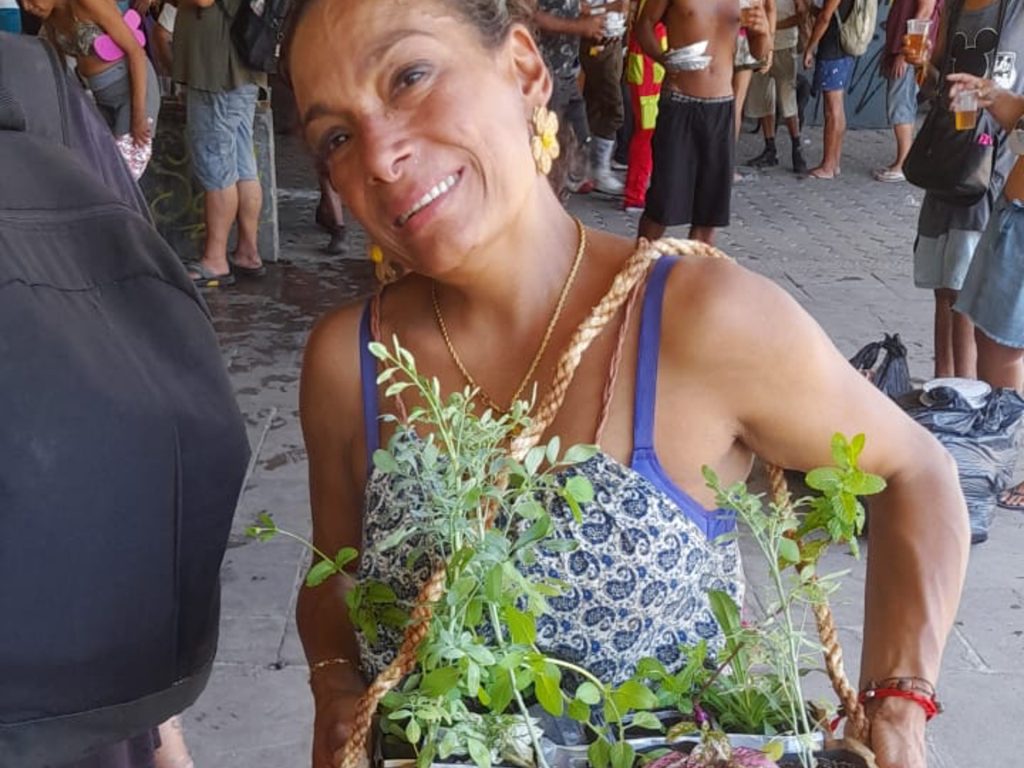
“I came from out of town. I had nowhere to eat, that is in the shelter. And it went on like that. And then someone said, ‘If you buy a little flower for 50 cents and sell it the following week, you can pay me a little more…’ And that’s how I sustained myself, that’s how it went. I never needed to prostitute myself. I never need to steal. It was only done through work.”
She says the experience of being a florist is “wonderful” since she learns something new every day and that she meets new people too. What Débora wishes people knew about the project is, “When we give of ourselves, we receive so much in return. We should give of ourselves without expecting anything in return, because things in our lives will work out in their own way. Just have faith and everything will work out.”
“Learning that someone no longer needs to sell flowers is the best news in the world”, Lorenzo said. “It’s what motivates me [and] motivates the project to move forward.”