

 EN
EN
Gabriele Dell’Otto: ‘The Real Superheroes Are the People Who Do Extraordinary Things in Their Ordinary Lives’
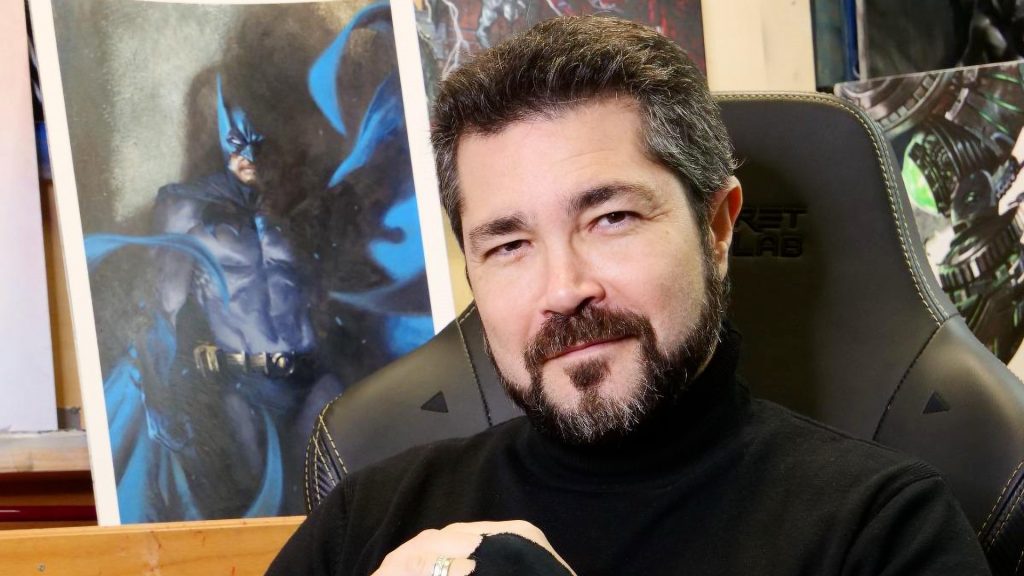
Celebrated Marvel and DC artist Gabriele Dell’Otto invites us to consider the people who are working to build peace as the real superheroes of our world. A profound discussion on responsibility, citizenship, and the challenge of doing the extraordinary in our everyday lives.
Gabriele Dell’Otto is an artist and illustrator who specialises in superhero art. With hands that have been drawing extraordinary stories with quick, confident, surgical strokes for years, he has created exceptional works of art. For example, he provided the artwork for Franco Nembrini’s book on the Divine Comedy, published by Mondadori.
Gabriele Dell’Otto also works for Marvel and DC, and so is an expert in superheroes. As United World Project has dedicated this month to the theme of ‘Art and Social Engagement’, we have asked him to talk to us about the relationship between superheroes and peace. And, more broadly speaking, about the values they stand for in these turbulent times. Gabriele invited us to his studio in Rome, and generously offered up his passion and expertise on the subject on the eve of an important event – one where he was going to be the main character.
What is happening tomorrow?
I am holding a personal exhibition of my own art – sixty pieces to be exact – all on the subject of superheroes. The event will be held at the Italian Cultural Institute in Miami, in the United States, which has already hosted several events for some of Italy’s leading brands. The exhibition, which will run until the end of April, is called ‘An Italian Vision of American Myths’. It explores the worlds of comics and cinema, and features several unpublished works. It is a retrospective looking back on how I have matured, both artistically and as a person. Over the years this growth has been the lens through which I have interpreted the theme of superheroes and the values they represent.
How have superheroes, over the years, championed peaceful values?
I think an important moment in history was September 11: it was like a call to responsibility for people working in comics. While it is true that inspiring hope through superheroes is nothing new, there was a real jump in quality – especially from Marvel.
![[Gabrielle Dell'Otto]. All rights reserved.](https://www.unitedworldproject.org/wp-content/uploads/2026/03/Gabrielle-DellOtto-3-689x1024.jpg)
In what way?
Marvel does a lot of work on allegory in their films: they follow the news, what happens in the real world, and tell it through their stories. Right after the tragedy of the Twin Towers, they addressed it…
In December 2001 with the image of Spider-Man, stood in shock at the destruction in front of him?
It might seem surreal – at the time I thought it was excessive – and it was a very delicate and risky decision. With time, though, it came to feel right, because it weighs on the reader’s conscience. A radical act that also ties into the idea that superheroes are always working to create peace. Of course, some of them pursue it through battle. If nothing else, by physically fighting.
Whereas good superheroes…
Have the strength and tools to take it on, and in an impressive way. There are some, though, who were specifically designed to be similar to us, but with special abilities. They are the exceptions.
For example?
Spider-Man. The ultimate symbol of good. One time a scriptwriter, while looking at some of my illustrations, joked: ‘One day I’d like to write the story of a Spider-Man who loses control, who messes up, who does evil.’ Then he added, ‘They’ll never do it. Spider-Man is untouchable.’
Howso?
Spider-Man has a very defined structure: it starts with a high-school boy who studies hard and really cares about his family. He has an enormous feeling of responsibility for his uncle’s death, an experience that taught him you can never do good through evil. Spiderman naturally gravitates towards joy, peace, and life itself. Like in ‘One More Day’, for example…
What happens?
Mephisto, a demon, appears and promises to save his aunt’s life if Peter obeys him. The price he will have to pay is removing all memories of his and Mary Jane’s marriage. Partly because the demon never tells the whole truth, Peter accepts, demonstrating just how important human life is to Spider-Man.
Are there other similar examples, outside of Marvel?
Well, DC Comics’ Superman: the incarnation of an alien demigod who has devoted himself to humankind. He also pursues peace without resorting to violence, and has a similar backstory to Peter Parker in Spider-Man; Superman fails to save his adoptive father, Jonathan Kent, from a heart attack. This fuels his desire to dedicate his life to serving humankind, and at the same time, it gives him the humility to recognise that he is not omnipotent, despite his extraordinary superpowers.
They both have family at heart.
Both start from the ‘small’ scale of family, then extend that to the entire world, fusing their superpowers with their moral code.
Would you say that superheroes can help us manage conflicts? Iron Man and Captain America come to mind.
They both strive for peace, but take two opposite approaches: one self-serving, and the other idealistic. This is why it is difficult to hold them up as role models, and they risk relational philanthropy. In Civil War, which is one of the best examples of superheroes in cinema, they all have different perspectives – both right and wrong points of view at the same time.
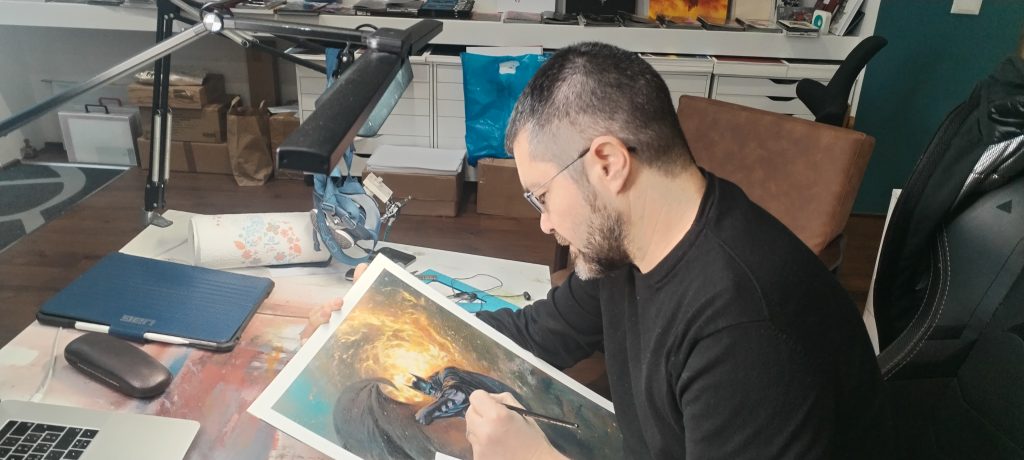
We are entering into the moral complexity that superheroes present, precisely because of these partially valid views.
From my work on Dante (Alighieri, the Italian poet and writer known for the Divine Comedy), I came to understand one thing…
Go ahead…
The fundamental difference between superheroes and Dante taking his purifying journey is that the former, despite saving many lives, often returns home wishing they could have saved more. When they do not fail completely. They represent what happens to all of us, with our inevitable failures and changes of heart, even when we are armed with good intentions.
Dante, on the other hand?
He understands that he cannot do anything except rely on those higher up. The difference between the poet and superheroes, then, is that Dante understands that, alone, he cannot even save himself.
An outlook that puts God at the centre…
Superheroes, who reveal a lot about our society, never achieve true harmony. Dante, on the other hand, comes before God and understands that everything on his journey had meaning; it was all worth it. ‘[T]he universe, seems separate, scattered’, he says. It is something I think we have lost, and it reminds me that superheroes can also be read as the manifestation of humankind’s desire for the divine. The real superheroes are the people who do extraordinary things in their ordinary lives. Even they have to find peace within themselves first and foremost, and a lot of superheroes are frustrated because they cannot find that internal peace. When you bang your head against an impenetrable wall – and it happens to everyone – you realise that your superpower is not enough. I think about people who have a lot of money, an impressive career, or a lot of power. Saint Augustine of Hippo has been teaching us this for a long time: ‘You were inside me and I was outside myself. And I was looking for you outside’.
If you always look on the outside, you risk finding nothing but idols…
It is the same with superheroes. We have to take in the messages they champion, without completely turning them into idols. We also have to be good at reading between the lines with comics – and their film adaptations. I remember James Mangold’s movie Logan, a very well-crafted film that centres around the search for a father figure. It reminds me how our society has deconstructed that figure, so much so that we no longer recognise its intrinsic value for young people. It is a superhero film that forces us to reflect on how much our responsibilities can benefit the lives of those around us.
Some stories are different from others, then?
Of course. If the theme of peace is conveyed by showing that a lot of people need to be killed to achieve it, is that a fair representation? You always have to remember: if you want to pursue the greater good, you cannot make a deal with the devil. Tolkien taught us that with The Lord of the Rings, but that kind of message is rarely seen today. We are asked to make a difficult judgment. Superheroes can be a good vehicle for lessons about peace, but it depends on who is writing them.
Otherwise, they can have the opposite effect…
Superheroes can also be dangerous at an age when critical thinking skills have not yet fully developed. Images are an incredibly powerful tool – whether they are from a comic or a film – and can make people think something bad is good.
Is it important to understand the subtext?
Absolutely, yes. The most powerful thing is not what they say, but the messages hidden underneath. For example, the series The Boys should be taken with a pinch of salt. It offers an interesting perspective on society, but on top of the somewhat gratuitous violence, it risks passing on the message that good and evil always come to look alike and merge.
Do you think the major superhero studios are just going with the flow now?
I think the search for good definitely exists in most publishing houses, but alongside the inevitable limits the industry imposes. Sales play an important role, and it goes without saying that Marvel, DC, and similar companies are careful about what they are selling. Also, now, there is canon that has to be respected, so they run the risk of becoming indistinguishable because of their inevitable overlap of themes. Whereas others, even important ones, perhaps bearers of truth, are considered controversial. Ironically! And that makes us question the idea of inclusion.
![[Gabrielle Dell'Otto]. All rights reserved.](https://www.unitedworldproject.org/wp-content/uploads/2026/03/Gabrielle-DellOtto-1-1024x1024.jpg)
It seems to me that superheroes need to be handled with care: there are a lot of controversies and nuances that can hide important pitfalls. Perhaps Spider-Man said it best: ‘With great power comes great responsibility.’ Do you agree that their educational value is undeniable?
Yes, of course. Let us turn our attention back to Superman: the purest incarnation of a superhero, with no dark sides. In general, I think that superheroes can spread messages and values that teach peace. And with the energy and imagination they inspire, they have the potential to really stay with children and young people as they grow up. I know firsthand stories of people who have found the tools and motivation to face hard times head-on. If there is something else superheroes teach us, it is to stand up to our own hypocrisy.
Useful!
Even superheroes, however, exist in a complicated society that is deceptive and highly polarised. A narcissistic society that has no real shared, collective ideals. A society where peace for some is war for others, and where the truth is easily hidden and not adequately defended. Same with honesty. It would be amazing to get back to a place where we were embracing ideals that bring us together and closer to the kinds of truths that benefit humankind. This is an urgent task we all need to face together, without hypocrisy.
Is there a lack of stories like that?
Actually, that came up in Avengers: Endgame, when Iron Man became a real superhero by dying. He directly sacrifices himself, revealing his true character; it is no coincidence that, in that moment, he says, ‘I am Iron Man’. By leaving his ego behind, by renouncing all personal ties, he gains full status as a superhero: I am such because I save others by sacrificing myself, leaving behind my ‘self’. He knows he is dying and snaps his fingers. The search for peace for all of us, metaphorically, means letting the ‘self’ die.
[© Gabrielle Dell’Otto]. All rights reserved.
Translated into English by Becca Webley