

 EN
EN
Latin America Celebrates the Economy of Communion’s Thirty-Fifth Anniversary

Thirty-five years ago a dream was born: the Economy of Communion. In late May Argentina will host an extraordinary celebration where people of all ages will come together to breathe new life into this project and write the future for a different kind of economy.
Economy and communion are two words that do not typically go together, except in ‘Economy of Communion’ (EoC): a project that also brings together reconciliation and a productive path forward for all of humanity. But what is the Economy of Communion? It is a different system, an alternative to the dominant economic model of capitalism. It is a chance to live differently, keeping gratitude and reciprocity at the core. It is a way of life that provides an alternative to the relentless accumulation of wealth and possessions that creates abundance, but also division and disparity, individualism and solitude.
The Economy of Communion: a Long and Beautiful Story
The Economy of Communion was founded in 1991 in São Paulo, thanks to the charismatic insight of Chiara Lubich, Founder of the Focolare Movement. Today, 35 years later, the EoC is bringing together entrepreneurs and executives; workers of all kinds; as well as consumers, students, and ordinary people. So many people around the world are committed to spreading the Economy of Communion’s culture.
How? Through concrete action towards an ongoing training project. Courses, meetings, and events for adults and young people – not to forget the production and manufacturing centres in the Focolare Movement’s citadels – are the spaces and tools with which the EoC is developing, something that concerns every social and age group.
A Culture of Giving
Chiara Lubich herself spoke about a ‘culture of giving’, where businesses and jobs exist to serve the common good. The goal at the EoC is for all wealth produced – profits, earnings – to go towards minimising the destitution, poverty, and exclusion disproportionately impacting the most vulnerable. When accompanied by job creation, developments in businesses, for entrepreneurs, and generally in the worlds of work and production guarantee social inclusion that is both productive and community-oriented.
‘We are convinced, in fact,’ you can read on the Economy of Communion website, ‘that you cannot remedy any kind of poverty that is not freely chosen without bringing disadvantaged peoples into active and fraternal communities – and, where possible, businesses and places of work. So long as those who can and must work do not have the opportunity, they will remain people in need.’
Celebrating the EoC’s Thirty-Fifth Anniversary
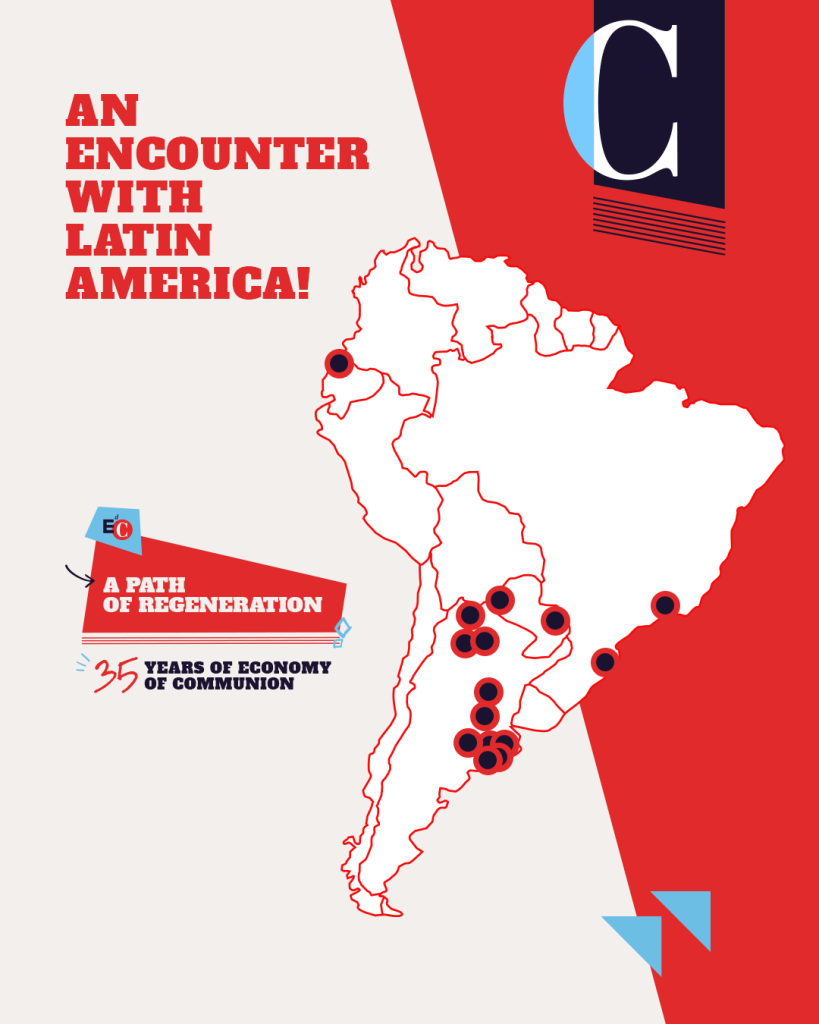
So there is a lot of beauty in the Economy of Communion. Representing a search for justice, for hope, and for the future, this extraordinary humanitarian project is celebrating its thirty-fifth anniversary in Latin America this year. To mark the occasion, a special celebration will be taking place from 25 to 30 May: a global meeting held in Argentina to celebrate this birthday together with the entire Economy of Communion network.
Twenty Local Initiatives: Phase One of the Event
The theme of the event will be ‘A Path of Regeneration: Thirty-Five Years of the Economy of Communion’, and it will be divided into two phases. In the first, which runs from 25 to 27 May, around twenty local initiatives across Latin America will welcome small groups to immerse themselves in the local communities that – despite their rich identities and traditional knowledge – are suffering the consequences of the current economic system. These communities are hoping to put the Economy of Communion’s culture into practice in their everyday lives. This encounter, therefore, promises to be very interesting and profound.
Isaías Hernando, coordinator for the Economy of Communion’s international commission, asserted: ‘We propose that each person immerse themself in the everyday lives of these local initiatives, so that – seeing the world from this perspective – they can experience the potential for regeneration and transformation that stems from communion and reciprocity.’ Read about the various initiatives and experiences you can take part in on their website.
Workshop: Phase Two of the Event
During the second phase of the event, running from 29 to 30 May, participants will come together in Buenos Aires for a day-and-a-half-long meeting, with a dynamic and collaborative programme of events, to celebrate the project’s first 35 years. This phase will also provide an opportunity for the global Economy of Communion network to work together and decide on future commitments. The programme will follow a workshop format, encouraging active participation and facilitating intense (and constructive) dialogue. Isaías Hernando added: ‘The goal for this phase will be to celebrate the EoC’s thirty-fifth birthday, but also to work towards implementing the next steps to better respond to the challenges of the current economic system and come that bit closer to realising the Economy of Communion’s mission.’
How to Take Part in the EoC’s Thirty-Fifth Anniversary Event in Latin America
Because celebration and education – present and future – go hand in hand, the Economy of Communion wants its extraordinary idea to spread. According to their website, ‘The EoC is based on the conviction that, without a new culture, a new economy cannot be created.’ Economic action is always a broader reflection of a way of life, of a worldview, which is why – ever since Chiara Lubich’s first flash of inspiration – part of the businesses’ profits go towards education on the culture of giving, primarily using the Focolare Movement’s training structures.
You might also be interested in: Pastificio Futuro: The Young Offenders Making Pasta and a Second Chance
The official page for the meeting in Argentina is already live and contains all the necessary information, as well as the form to sign up. The event in May is open to anyone already part of the EoC’s global network; those participating in one of their projects; professors; students; researchers; entrepreneurs; social entrepreneurs; members of organisations, movements, and networks with similar missions; as well as anyone interested in the project.
Translated into English by Becca Webley.