

 EN
EN
From Picasso to Banksy: ‘Art Does Not Just Represent the World; It Can Transform It’
Art is not just memory, but a living force. Art historian Giulia Spoltore guides us through the great works of war-defying art, illustrating how beauty can transform society and create a universal culture of peace.
Peace is humankind’s ultimate goal, its dream, its ideal, but also its responsibility and duty. This is the reason why the theme of peace is so prevalent in art. Together with Giulia Spoltore, art historian and official at the Ministry of Culture’s Istituto Nazionale per la Grafica (National Institute for Graphic Design), we explore the theme of peace through several important works of figurative art. We begin with a piece entitled The Peace of Kyiv, by Antonio Canova.
Giulia, can you tell us a bit about this sculpture?
The Peace of Kyiv has a multidimensional and timeless significance. The piece was commissioned by Nikolay Petrovich Rumyantsev, a diplomat and advocate for peace treaties in Russia, and completed between 1812 and 1815. The sculpture embodies an idea that Canova grappled with while Europe was being torn apart by the Napoleonic Wars. The artist speaks to the present, while remaining firmly rooted in the classical foundations of European culture.
How?
The very choice of marble – something the client requested – evokes classical antiquity and its desire to be immortalised in stone. Iconographically, Canova constructs the figure through an ancient lens: the figure of peace resembles the Greek Nemesis, a symbol of distributive justice. Whereas the snake, which is borrowed from Roman numismatic tradition, symbolises war being dominated and neutralised.
A symbolic serpent?
In Christianity, the snake is a symbol for the devil: the personification of evil. This is just one of many deliberate connotations the artist confers upon the work. Even the choice of Latin for the inscription, which was the result of diplomatic negotiations, carries a political and cultural message: a shared language for shared ideals, signalling hope for harmony among European nations.
It is a political piece, then…?
The subsequent history of this sculpture shows that, despite itself, it has continually been involved in geopolitical debate. Left to the state and displayed in the first public museum in Russia after Rumyantsev’s death, the sculpture was transported from Saint Petersburg to Moscow, and later to Kyiv in 1953, at the request of Nikita Khrushchev. Its journey is very revealing.
In what way?
The Peace of Kyiv became part of Ukraine’s cultural identity, a symbolic legacy that has taken on even greater significance in the current international climate. With the original marble relocated to protect it during the war, a plaster cast of the Canovian sculpture was exhibited at Palazzo Vecchio in Florence in 2022. This sibling sculpture was displayed just a short distance from The Fourth Estate, by Pellizza da Volpedo, almost as if to say: peace belongs to those who wholly oppose the madness of war.
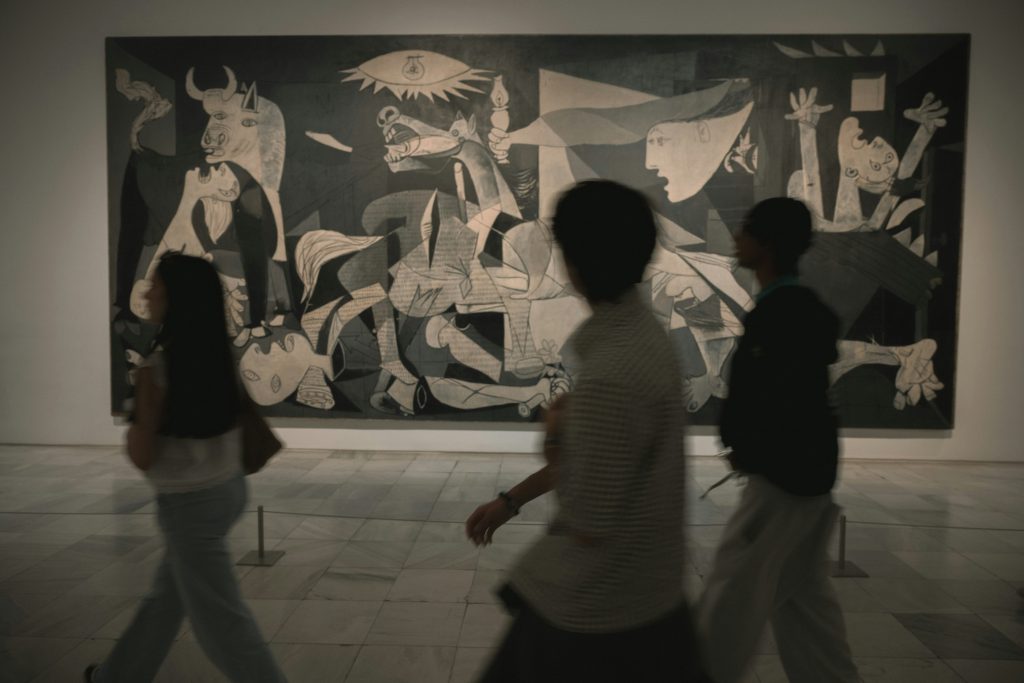
When I think about peace, Picasso springs to mind. What does Guernica, the painting about war, tell us about peace? And how does this relate to the fact that, after the war, Picasso became an activist for the peace movement, painting the Dove of Peace and the Temple of Peace?
Guernica, which he painted in the spring of 1937, is one of the most powerful anti-war paintings ever made, and is therefore a profound expression of peace. Picasso does not convey this naturalistically, but by vehemently denouncing barbarity; he depicts what happens when peace is betrayed. The violence that permeates the canvas – the screaming mother, the gored horse, the blinding light of the bulb, the dismembered bodies – is not sensationalised. Instead, Picasso evokes a collective pain, with no heroism, no celebratory narrative, and no justifications. Measuring over three and a half metres high and seven metres wide, the large scale of the canvas serves to emphasise the crushing weight of the abomination that war represents for man.
Do the colours he has chosen reflect the same darkness?
The monochrome palette evokes an absence of life and joy – something that colour conveys through its variety of shades. It is this radicalism that makes Guernica a work of peace. Picasso rejects all rhetoric and reminds us what war really is: an aberration that destroys humankind.
Is Guernica the spark for Picasso’s post-war activism?
Certainly. The trauma of the Spanish Civil War and the Second World War marks a turning point in his life. From the fifties onwards the artist feels the need to translate his moral stance into new images that can directly speak to a vast audience. This is how two of the most powerful universal symbols of the twentieth century were born: the Dove of Peace and the Temple of Peace.
The Dove…
Chosen as the emblem for the 1949 World Peace Council, it became a global symbol because it combines a concise form with universal significance. While not strictly a political symbol, the dove is an archetypal image deeply rooted in the Judeo-Christian religion. For example, the dove that signalled the end of the flood to Noah, or the Holy Spirit descending in the form of a dove at Jesus’ baptism, prompting his mission of salvation.
And the Temple of Peace?
This lesser-known work comes from a more meditative, almost sacred place, conveying a spiritual interpretation of peace. The installation consists of a series of large paintings made between 1952 and 1953 for the chapel of Vallauris Castle, in Provence. They are now housed in the National Picasso Museum, War and Peace. Picasso wants to transform this sacred space into a place devoted to reflection on peace: a secular and symbolic temple.
What happens next?
The artist incorporates the curvature of the vaulting and the cohesion of the space, making them integral parts of the piece. He does not limit himself to decorating: he reconfigures the space to create what we might today call an ‘immersive experience’. The series measures over 100 m², and is painted onto flexible panels moulded to fit the shape of the walls. The piece tells of two worlds: the world of peace and the world of war. Peace invades war with a naked guard holding a sword, a scale, and a shield adorned with a dove.
Similar to Canova’s The Peace of Kyiv?
Exactly. The figure I love the most is the winged horse pulling a plough driven by a child: a powerfully symbolic image. It alludes to Pegasus and divine inspiration, but also to the prophecy of Isaiah: ‘They shall beat their swords into ploughshares,’ transforming instruments of death into instruments of life.
Three works that follow the same trajectory…
Picasso tackles the subject of peace because he has experienced war. Guernica is the act of denunciation; his post-war pieces are a proposition. Picasso is telling us: after having shown what war is, I am called to reflect on what peace could be. This continuity is what makes his contribution so significant. Picasso reminds us that peace is not just the absence of war, but an active process, a personal and collective duty, a vision that must continually be invented and reinvented. Art does not just represent the world; it can transform it.
As can places…
Certainly. Living in Rome, I cannot neglect to mention the Ara Pacis, the great altar erected by the Roman Senate in honour of the peace Augustus established in 🇦🇩 9 after his travels in Spain and Gaul. It is a piece of propaganda that legitimises the political power of an exceptional historical figure, but it also shows us how peace can be a call to arms for anyone. Above all, I want to mention the church of Santa Maria della Pace. The Ministry of Culture is releasing an incredibly important book about the church, which I have the distinct privilege of curating with three highly influential architectural historians: Paul Davies, Maria Beltramini, and Augusto Roca De Amicis.
What is it about?
The book tells the story of an extraordinary church that preserves works by Raphael and Orazio Gentileschi, and owes its seventeenth-century restoration to Pietro da Cortona. Now we are finally able to give it the attention it deserves.
Where does its name come from?
It is a story that combines miracle, popular worship, and papal policy in the heart of fifteenth-century Rome. A particular sequence of events leads to the construction of Santa Maria della Pace: a popular miracle, a recovery attributed to the Virgin, a vow made by Pope Sixtus IV while under the threat of war, before peace is found at last. The building itself, and the fact that it is dedicated to ‘Madonna della Pace’, are markers of its story of suffering, faith, and gratitude. A story that transformed an image wounded by sacrilege into the spiritual centre of a glorious new Roman sanctuary.
What do we find in Santa Maria della Pace?
Pietro da Cortona’s decorative direction places an emphasis on the allegorical figures that breathe life into the arches and counter-façade. They are the Virtues that represent the ‘moral code’ inscribed on the structure: Fortitude, Prudence. The seventeenth-century figures blend harmoniously with the visual journey one takes through the church, with the two allegorical representations of Peace and Righteousness located at the top of the main altar’s tympanum, but also on the counter-façade. They are essential parts of the artistic direction, with the intention of elevating the name of the church itself. Peace is founded on the dual biblical axis that links Mary to the gift of Messianic harmony, while the majestic and divine virtue of Righteousness calls to mind the image of reconciliation found in Psalm 85, in which ‘Righteousness and peace have kissed’.
Allegory not only as decoration…
They are theological tools, guiding your gaze along the symbolic axis that connects the presbytery to an octagon. They express a moral stance that stems from Peace – a divine gift and the foundation of the church – and branches out into Virtues. The figures invite those who enter the church to move through a space that is not just a building, but also a journey of spiritual elevation.
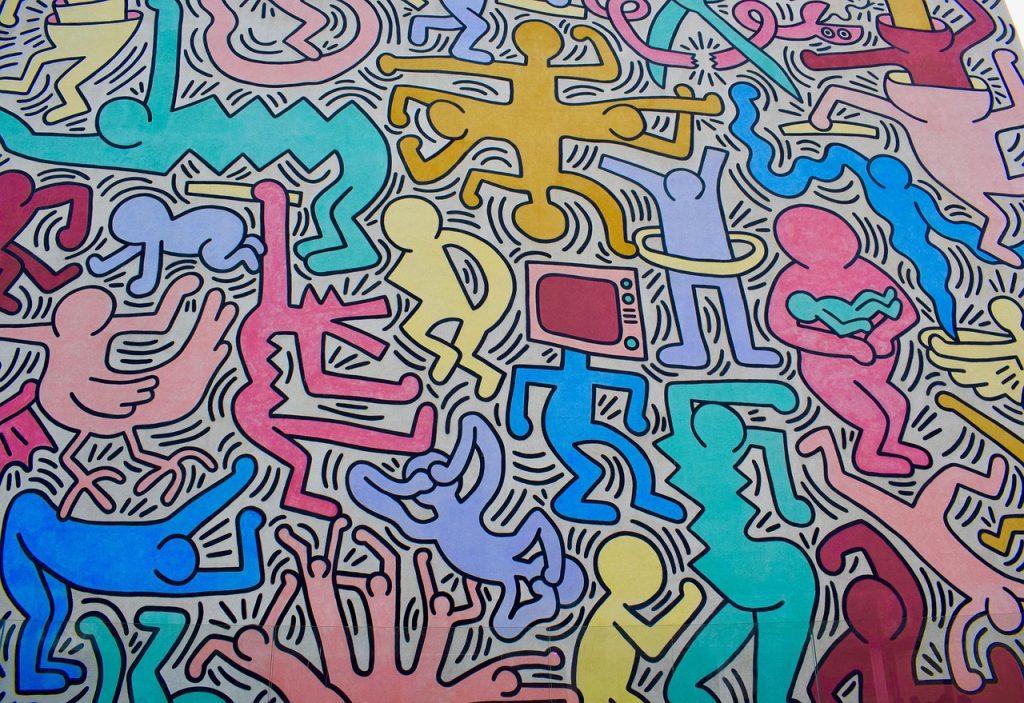
Shifting our focus closer to the present day, I am struck by Tuttomondo (literally, ‘WholeWorld’), the 1989 Keith Haring mural, painted onto the Sant’Antonio Abate church in Pisa. What do you think of it?
Tuttomondo is the American artist’s last public mural – and the only one thought of as permanent, I believe. Haring is invited to Pisa and, moved by the town, decides to leave his mark. And, with the help of local students and teachers, it is completed in only four days. The town council and parish priest of the church allow him to work on the large north wall of the convent, which had been partially destroyed by bombing during the Second World War.
What do we see in the mural?
We see about thirty figures, from people to anthropomorphic animals, each characterised by the artist’s distinctive black outlines and vibrant colours. There is no central focus: the mural seamlessly, dynamically flows, a bit like our everyday lives. Each figure is a symbol, a visual story of the peace, harmony, cooperation, and unity of humankind.
What are these symbols?
There is a cross formed by four figures, which represents the Pisan cross, a symbol of the city. Anthropomorphic scissors cutting a serpent alludes to the victory of good over evil. The person holding up a dolphin invites us to care for nature. Multicoloured human figures sharing the same form call for equality and overcoming racism. The mother cradling a child celebrates maternity and the continuity of life. The figure with its arm bending around and connecting to its leg evokes the infinity symbol.
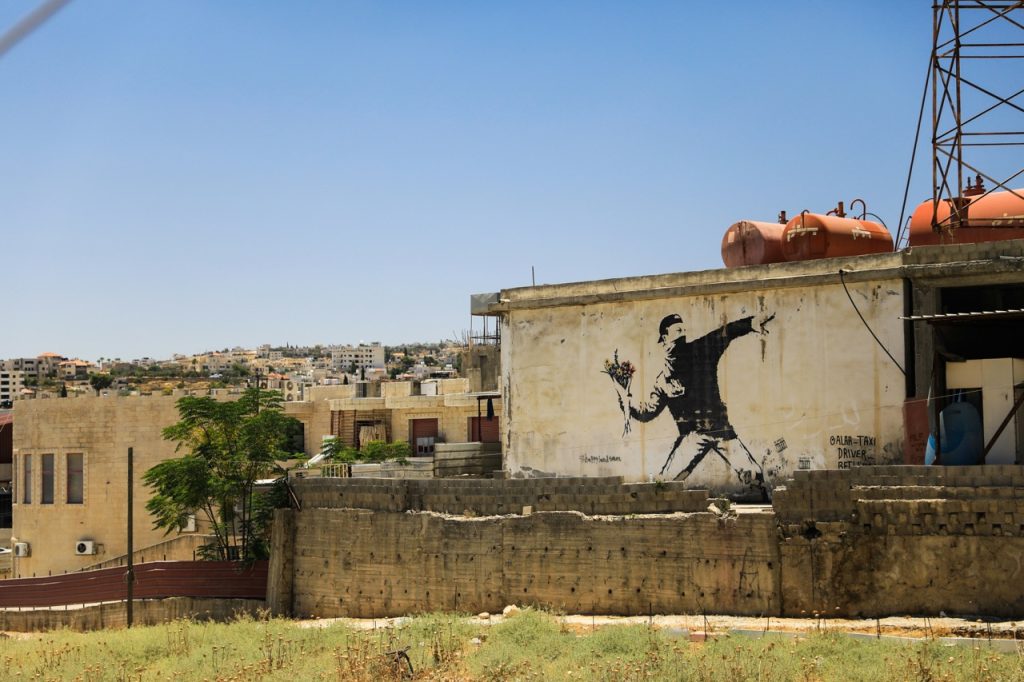
An even more recent example I can think of is Banksy’s Dove of Peace, which depicts a dove wearing a bulletproof vest.
Painted onto the separation wall in Bethlehem in 2005, Dove of Peace shouts a clear and powerful message. As the crosshairs on the dove’s chest suggest, peace is always under attack, and so must be defended: not with an armed battle, in my view, but by finding a bulletproof vest to put on. We know that the only bulletproof vest against war is love, in all its forms, from kindness to self-sacrifice.
You might also be interested in: Aeham Ahmad: the Pianist of Yarmouk in Syria’s Bombed Skies
Michelangelo Pistoletto is another artist who explores the relationship between art and peace. I think of The Preventive Peace…
The installation was unveiled in 2023 at Palazzo Reale in Milan, and it marks an invaluable piece of work in the artist’s latest phase of research, focusing on social transformation through art. The Preventive Peace filled the monumental Hall of the Caryatids, which had been damaged by the 1943 bombing and intentionally left with those scars. In Italy restoration does not mean changing history, but rather accepting the world’s many layers of history – in this case, recording the marks left by the madness of war. A place steeped in history, it was also the site of Picasso’s 1953 Guernica exhibition. The Preventive Peace was in very close conversation with the history of the hall.
What did the installation consist of?
A labyrinth of corrugated cardboard, spread out across every last inch of the hall. Inside the labyrinth were pockets and crossroads that housed some of Pistoletto’s most significant works. Most notably, his Venus of the Rags, Mappamondo (literally, ‘WorldMap’), The Apple Made Whole Again, and Dove of Peace. Visitors were invited to follow a winding, deliberately disorienting pathway, conceived as a metaphor for the internal pathways we each must walk down to ‘escape the labyrinth of the everyday and establish preventive peace’.
What is preventive peace?
It is the conviction that peace is not the result of conflict, as has traditionally been the case in global politics, but a process that must be established beforehand, by taking individual and collective responsibility. As Pistoletto himself states, art must put people ‘at the centre of a responsible societal transformation’, and actively participate in forms of democracy that broaden the horizon of the possible. The labyrinth of The Preventive Peace held an additional layer of symbolism, inviting visitors to recognise the ‘monster’ of the conflict, but also the ‘monster’ of our twisted minds.
Translated into English by Becca Webley