
 EN
EN
AMU, 40 years of commitment to development and reciprocity among people
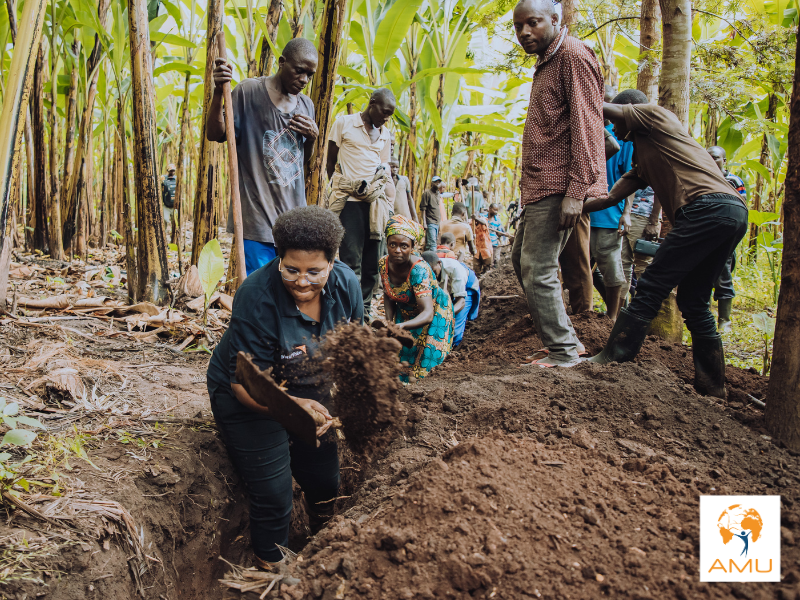
From Indonesia to Sri Lanka, from Burundi to Ecuador, AMU supports communities that take the lead through concrete projects that generate change and new opportunities, strengthening local capacities and autonomy.
AMU (Action for a United World) is celebrating 40 years of activity. Born as an expression of the Focolare Movement within its social engagement, it is a response to the basic needs of people and communities living in critical and vulnerable conditions.
This commitment has marked the life of the Movement from its very beginnings, gradually expanding across the world where communities that are sensitive to the challenge of inequality and social and economic imbalance have emerged. In an inspiring way, its founder Chiara Lubich called, in an evangelical sense, to “die for one’s own people.”
To support these actions, a network of financial aid was created with the involvement of Focolare communities in Europe, Asia, Africa, and Latin America. Over the years, this network became more structured and eventually led, in 1986, to the establishment of an international cooperation NGO.
Stefano Comazzi, president of AMU, explains that those were years of strong social engagement and momentum, “during which cooperation NGOs played a decisive role in spreading solidarity among people and nations. AMU joined this ‘mission’ with its own specific contribution.”
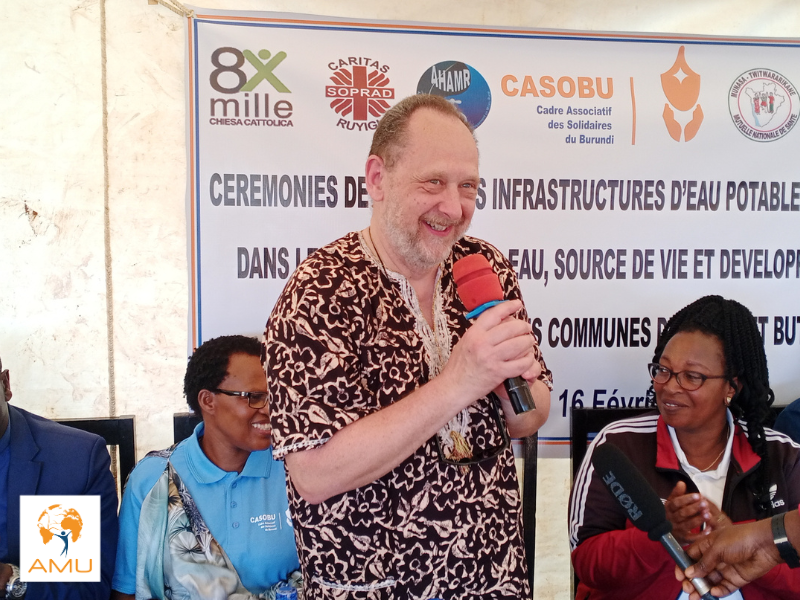
In its statute, AMU defines itself as follows: “We contribute to achieving the highest possible degree of reciprocity among people, communities, and populations, strengthening their capacity to unlock their development potential.”
Inspired by the ideal that guided Chiara Lubich, AMU’s founders set themselves an ambitious goal: contributing to the realization of a “United World”. A goal that is never fully completed, based on the continuous commitment of every person who wishes to orient their life according to the spirit of the Focolare Movement.
And AMU works towards this within its own field
By acting in international relations, helping populations and nations share resources and unique characteristics, fostering mutual enrichment that goes beyond the financial dimension and helps make humanity an authentic, great, and united human family.
For this reason, is the concept of reciprocity very important?
A reciprocity that is not based on “do ut des” (“I give so that you give”), but is open, generative, and free of beneficiaries dependent on benefactors. A reciprocity that places the dignity of every person and community at its center. Each person both gives and receives relational and material goods. This unlocks talents and potential that social and economic marginalization otherwise stifles, leaving people passive and lacking self-esteem.
This year AMU turns 40
A great milestone! It is moving, but I experience it above all as a responsibility to make the intentions and prophetic vision of the founders relevant today. I am deeply grateful to them for what they accomplished and for the legacy they left us. We are called to bring the statutory mission to life in a very different—and more complex—context than the one in which it was founded. I also feel responsible towards future generations: they are bearers of rights, and our decisions will have consequences for them.
AMU is made up of humanity, but also of numbers: 873 projects completed; 14 currently underway; 294,000 beneficiaries reached in the last year. What do these figures tell us?
They are important for understanding reality and guiding choices and pathways, but behind them are people, each with their own stories, challenges, and goals achieved or still to be achieved. In our communications and social reports (published annually), we prefer to give voice to these people and their communities—stories of those who break free from marginalization and poverty, getting involved and engaging their communities in acts of solidarity and awareness on cooperation and development issues.
Over the years you have gathered many beautiful and inspiring stories.
From the children in the outskirts of Nairobi who sent just over three euros for an emergency initiative in Asia, to the solidarity within community microcredit groups in Burundi, where some members—unable to repay their loans on time due to family emergencies—were supported by others. When I explained our model of community microcredit, the parish priest of a community in Burundi said: “This is the same experience as the early Christian communities!”
Among the projects completed and ongoing, are there any you would like to highlight?
I have vivid memories of those in Indonesia, in the province of Aceh, and in eastern Sri Lanka after the devastating tsunami of December 26th, 2004. These were areas of civil war, and in the first case, members of the movement managed to gain trust and implement projects of reconstruction and income-generating activities. In Sri Lanka, we were able to bring together Buddhists, Hindus, Muslims, and Christians.
More recently?
A very encouraging experience that involved the youth engaged in active citizenship courses in Syria: girls and boys who grew up in a system where such experiences were extremely difficult. In the chaos of the civil war, meeting university graduates, Christians and Muslims in dialogue with one another, was, for me, a breath of hope. They all felt Syrian and were dedicated to the good of their country, rather than to religious affiliation.
Equally powerful were the stories of forgiveness and reconciliation heard in Burundi, where the killing of family members has marked the lives of almost every family in the country forever.
Strong stories, but also stories of hope.
Such as one from Goma, where political corruption is compounded by the destruction of infrastructure and other heavy constraints linked to the war for control of mineral resources. In such a chaotic context, a cooperative was created to provide employment for people with physical disabilities, along with a paralympic sports organization.
What is AMU’s way of working?
First and foremost, listening, respectful attention: finding solutions together with the people involved in the projects, through a participatory process that also includes civil authorities. Our approach has always been characterized by supporting local groups rather than sending experts or volunteers from abroad to lead projects. In the spirit of “growing together,” it is essential to respect each person’s timing and path: we do not push for decisions but wait for them to mature fully and be shared. We accompany the process discreetly, without replacing local counterparts. Mutual trust and transparency are indispensable conditions.
That seems like true relationship.
Listening and mutual trust to build active protagonists, not passive beneficiaries. Technical and vocational training, combined with the development of all dimensions of the person. Horizontal partnership and capacity building of local associations and groups, along with connections and exchanges of experience between groups and communities where projects are implemented and supported through solidarity actions.
A lot indeed!
For us, however, the spiritual dimension is also essential, as it often fosters encounter and mutual appreciation among people of different religions: one experiences the value of interreligious dialogue and its fruits in social and civic life.
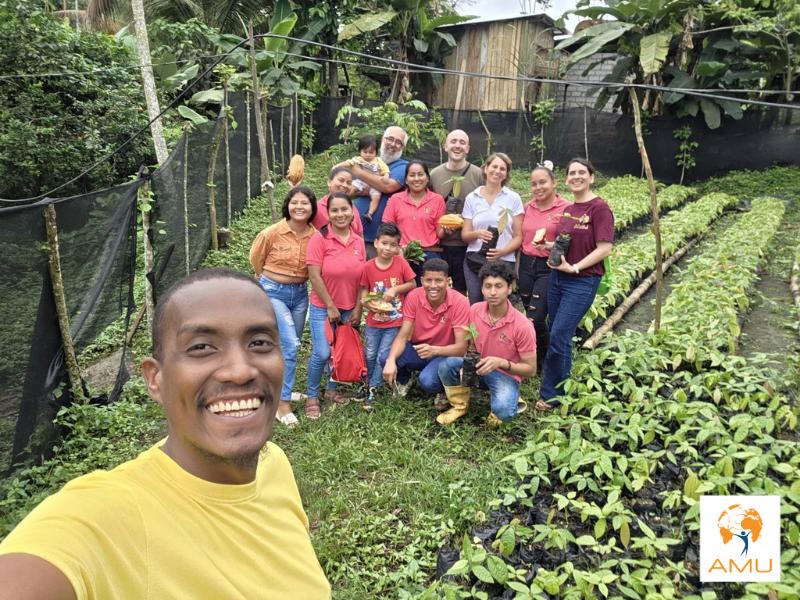
Another AMU project is in Ecuador, in the province of Esmeraldas, which has a very high poverty rate.
It is called “Sunrise,” evoking the hope of a new beginning. It is a training pathway that starts from work, offering entrepreneurial training to young farmers who already support their families’ productive activities. Thanks to the training received, three collective entrepreneurial initiatives have been launched, capable of adding value to local resources such as coconut, cocoa, and livestock: raw materials transformed into products for the local market. At the same time, these youth also take part in training and practical activities for environmental protection. This part of the project was born from their own request: protecting nature is essential for the future of their communities.
Does this project reflect AMU as a whole?
“Sunrise” fully reflects AMU’s style: starting from people, carefully listening to the real needs of communities, and building sustainable pathways together that can generate real and lasting change over time.
There is also a project in Burundi.
The project “Water, source of life and development” is being implemented in the very poor province of Cibitoke. Here, access to drinking water has historically been almost non-existent. Women and children must walk kilometers to reach often contaminated springs, with serious consequences for health, access to education, and quality of life. From this listening process a project implemented together with the local partner CASOBU, to restore dignity and a future to rural communities was born.
How do you operate in this case?
By rehabilitating or building a water network of over 25 km, restoring springs, installing reservoirs, public fountains and ecological latrines, as well as training the community in the sustainable management of water.
Not just technical infrastructure, then?
Primarily a community-driven process, with many jobs carried out directly by the inhabitants, who become the guardians of the resource.
Another paradigmatic AMU project, would you agree?
Because it brings together AMU’s core pillars: the centrality of fundamental rights such as water, health, education, work, and dignified living conditions. The active involvement of communities is essential, within a holistic vision of human development.
Starting from the primary good of water.
Which becomes a vehicle for health, education, employment, and social redemption. This project is expected to reach more than 21,000 people, but many more have over the years been protagonists of similar initiatives.
What is AMU’s relationship with institutions?
With both public and private institutions, AMU does not present itself merely as a funding applicant or technical agency, but seeks to build partnerships that foster reciprocity and mutual enrichment through direct contact with the communities where projects take place.
To sum up AMU’s work, could we say that instead of giving a hungry person fish, you teach them how to fish?
This is a very common saying, but not always “our” way of fishing is the most appropriate: the Western approach tends to focus on efficiency and return on investment. In other contexts, relationships matter more, as does the community’s ability to generate and preserve bonds of solidarity among people and with nature. For this reason, we must learn together what the best way of “fishing” is. We ourselves come out enriched, and this helps us experience more sober lifestyles that respect natural rhythms.
What does it feel like when a new project is born?
The feelings I remember most clearly are those of the first meetings, when it is still not clear what can be done. Through dialogue and analysis of the context, the possible project gradually takes shape. At the end of this not short or linear process, the project document and the agreement between the parties are written. It is an important milestone. Then, of course, the mid-term and final evaluations bring the most beautiful and encouraging moments, with the joy of people celebrating the results achieved.
You work with many countries, under the banner of your acronym: “United World.”
This is a consequence of the spirit we have inherited from the Focolare Movement: unity is its defining feature, and we try to express it in our field. The united world we aim to contribute to building does not have a dominant culture and does not accept areas or people defending privileges or positions of power. More than a place, it is a condition in which every person feels an active member and builder of their own community and of the human family seeing and recognizing in others what they wish others would see and recognize in themselves, in their deepest essence.
You work in education, health, employment, and emergencies. How do you manage to operate in so many directions?
In 40 years of experience, we have built up skills that continue to grow with the contribution of new people. I am pleased to see that our current team includes people from Italy, Brazil, Paraguay, Uruguay, Sierra Leone, Jordan, and Ukraine, with diverse skills and experiences. There is also the capacity of our local partners to develop specific expertise that becomes a shared asset. I would also highlight the importance of our contribution to Global Citizenship Education, which is another pillar of AMU’s work and is active in schools, youth groups, and educational communities.
What is AMU’s relationship with dialogue and peace?
We engage in dialogue with all stakeholders connected to a place and a project proposal. Indirectly, this also extends to intercultural and interreligious dialogue, and dialogue between generations, people, and cultures. Regarding peace, we feel a strong vocation to act both in the practical dimension—mainly humanitarian aid in contexts of war or disaster, thanks to Focolare communities around the world—and in the dimension of witness, advocacy, and information. For this reason, AMU has supported the Living Peace International project, which has been able to strengthen and expand as a result.
To conclude, a reflection on the “united world” today, amid wars and violence: when is it difficult for AMU to work in such a climate? And how much does this difficulty fuel your desire to respond, to nurture hope and good?
Difficulties are many, and it is painful to see the loss of hope among so many people and nations forced for years to endure war and violence. I think of our friends in Syria, Lebanon, Palestine, Congo, and Ukraine. On the other hand, however, we also see in some of them an extraordinary capacity for resilience and courage despite the many struggles they have suffered.
In what way?
They manage to look beyond their personal suffering and take on the needs of those around them. I recall of a woman I met last year in Beirut. While she was helping displaced compatriots, she received a message on her phone informing her that she had only a few minutes to leave her home. Of her entire building, nothing remained but a pile of rubble. Her whole life was buried there: books, memories, personal belongings.
And yet?
She continued to dedicate herself to helping her people and that testimony is worth more than a thousand words.