

 EN
EN
“Love for one’s neighbor becomes the foundation of a more just society”
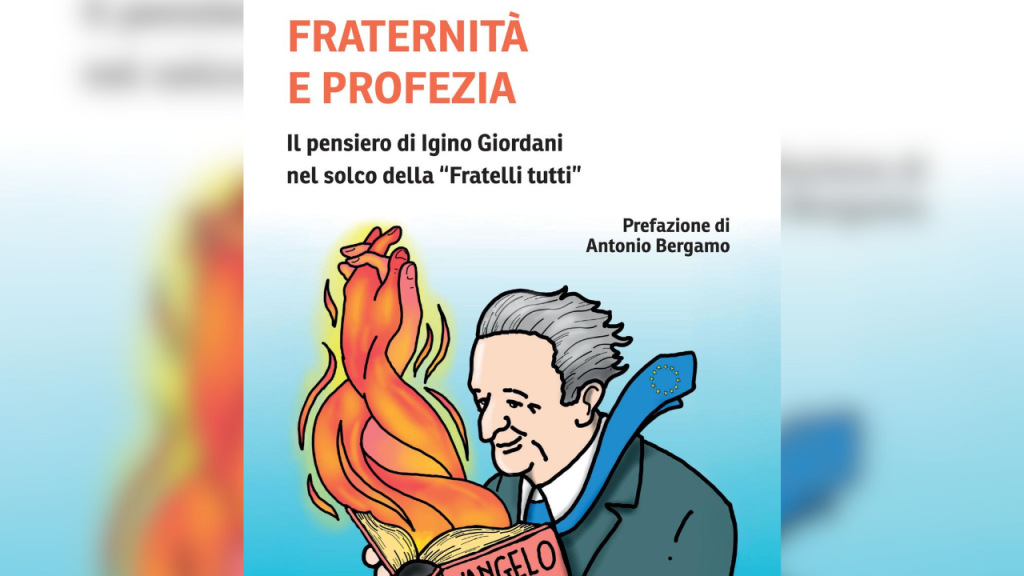
Stefano Zaffino, author of Fraternità e Profezia (Fraternity and Prophecy): The Thought of Igino Giordani in the Wake of the Encyclical Fratelli tutti, reflects on fraternity as a response to the conflicts and divisions of the contemporary world.
How could United World Project fail to take notice of a book whose title contains the word “Fraternity”? How could a text whose subtitle reads: The Thought of Igino Giordani in the Wake of the Encyclical Fratelli tutti (Brothers All) not capture our attention? For this reason, faced with the work written by the young Stefano Zaffino, published by Tau and entitled Fraternity and Prophecy, we felt it was a valuable opportunity to engage in dialogue with the author.
In a certain sense, the book connects the thought of Igino Giordani — co-founder of the Focolare Movement together with Chiara Lubich — with that of Pope Francis, the pontiff who passed away just over a year ago, within a global context marked by ongoing political tensions and conflicts.
Fraternity and Prophecy: The Thought of Igino Giordani in the Wake of the Encyclical Fratelli tutti
The underlying question which perhaps already contains its own answer is therefore the following: What role can Christianity, and certain great human examples of Christian witnesses, play in building a new world where peace and fraternity are not merely invoked, but become visible realities?
The pages of Fraternity and Prophecy speak to us of a solution, a kind of antidote to this crisis: a social medicine called fraternity. If applied to civil society and to politics understood in its highest sense as service to others it can transform relationships between individuals and peoples, leading us to see the other as a brother or sister.
Igino Giordani offers us these words through “the social message of Christianity”: “Christianity makes us kin with Christ and, through Him, with God, through the closest degree of kinship, which is fraternity.” Therefore, as we read in the brochure accompanying Zaffino’s book, “retracing one of the passages of the Bible recounting the story of Cain and Abel, our response will no longer be Cain’s: ‘Am I my brother’s keeper?’ Instead, we will finally know how to care for one another.”
For all these reasons, we decided to speak with Stefano Zaffino (graduate in Religious Studies from the “Don Tonino Bello” Higher Institute in Lecce and teacher of Catholic Religion) about this compelling work of his. And we began at the beginning.
Stefano, how did the idea for this beautiful book come about?
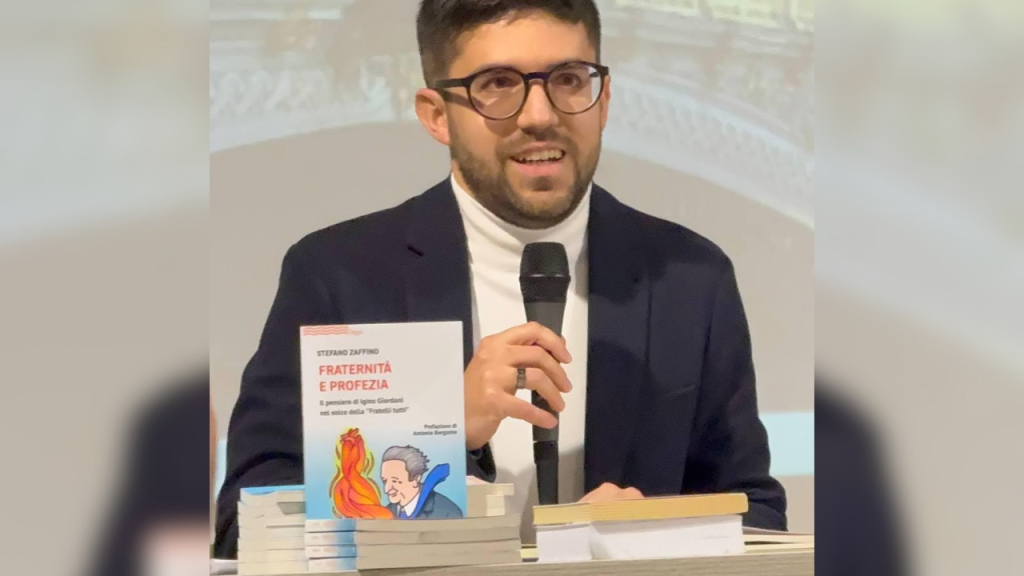
The book began as a thesis project during my years pursuing my master’s degree in Religious Studies. Over the course of about two years, I learnt about the figure of Igino Giordani, supported by Professor Don Antonio Bergamo (who also wrote the book’s preface): a lecturer and director of the ISSRM. However, Fraternity and Prophecy was also born, and above all, as an antidote to the violence of our times, in which, almost daily, people increasingly regard their brother or sister as an enemy to defeat.
How did you connect Igino Giordani’s thought with the encyclical “Fratelli tutti”?
Igino Giordani and Pope Francis speak the same language: the language of love. And when we speak of love, we are certainly speaking of a universal concept. Both, though in different historical periods, address the theme of fraternity. Giordani did so as a response to the totalitarianisms of the twentieth century, which had plunged humanity into suffering and hatred. For Pope Francis, fraternity takes on a global value, capable of creating a new world order based on peace and brotherhood.
What did you discover about Igino Giordani during this journey, and how relevant are his thought, teaching, and witness today?
Giordani remains profoundly relevant because fraternity can never be taken for granted, nor can its value ever become outdated. In a world torn apart by divisions, love for one’s neighbor becomes the foundation of a more just society and above all, it reminds us that each person can become the guardian of his or her brother or sister.
To what extent does your book, directly or indirectly, also speak about Chiara Lubich?
Meeting Chiara Lubich was decisive in Igino Giordani’s life: through her, he discovered a new way of living Christianity. Up to that point, he had experienced a primarily social Christianity, while Chiara also possessed a deeply mystical dimension, with great sensitivity towards interior and communal life. Both shared the dimension of fraternity, because every person is both brother or sister and child of one Father.
Why did you choose the title Fraternity and Prophecy?
I chose this title because fraternity and prophecy are two words closely linked to the human dimension. Fraternity concerns the bonds between human beings and fosters mutual care and solidarity. Prophecy is not the prediction of the future; rather, it is the ability to live in the present while denouncing everything that dehumanizes us. It is also the ability to call people back to a deeper truth.
Your book was presented in Andria. Was there anything in particular that struck you about that evening?
Over these months, I have had the privilege of taking part in several presentations of the book. I began in San Pietro Vernotico, at the parish of San Giovanni Bosco, where I took my first steps as a Christian. There, I had the chance to meet again many people who saw me grow and mature in faith. In Andria, on the other hand, I met many wonderful people, and what struck me most, despite never having been there before, was the strong sense of participation and engagement. I carry beautiful memories with me, and after this experience I am even more convinced that fraternity is possible, even in our complex times.