

 EN
FAO’s MuNe Museum: “Food Brings Us All Together, Yet Tells Different Stories”
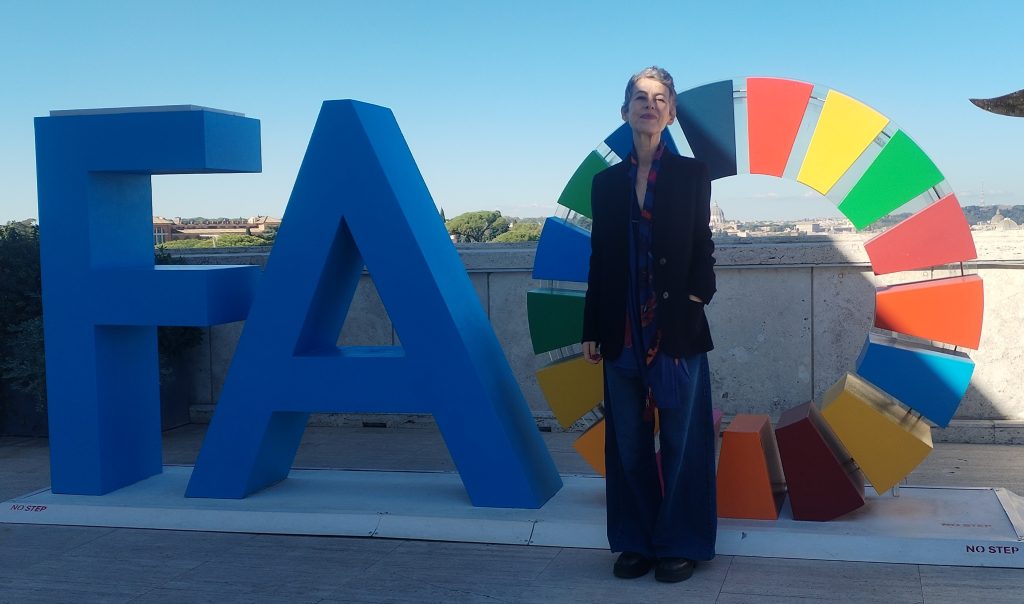
The FAO’s MuNe Museum transforms food into a universal language. Art, science and sustainability come together to help us understand today’s food challenges.
There is a special museum in the heart of Rome, between the Colosseum and Circo Massimo. It is called MuNe and is located in the FAO (Food and Agriculture Organization of the United Nations) headquarters. We went to visit it with Sabina Zaccaro, the Organization’s Communication Officer and one of the many people behind this project, which explores food, the environment, cultures, peace and unity among people, building an ideal bridge between the past and the future.
Sabina, how did the idea come about?
MuNe was created to mark the FAO’s 80th anniversary. Above all, it was an opportunity to find a new way of telling the story of the Organization’s mission and its connection to each of our daily lives. Food is a universal language that brings us all together, yet at the same time tells stories of differences, traditions and our history. This is where the idea of creating a space to bring people closer to major food and agriculture issues through art, culture, science and innovation came from.
How did you envision MuNe?
From the very beginning, we imagined it as an educational and outreach platform, where knowledge becomes an experience capable of sparking curiosity, awareness and participation. In this journey, our relationship with schools and younger generations plays a central role: we want to give the youth the tools to understand the challenges surrounding food and sustainability, and encourage them to see themselves as agents of change. There was another ambition, too.
What was it?
To open the doors of the FAO headquarters in Rome, a place traditionally dedicated to international cooperation and diplomacy, and transform it into a space that is more accessible to citizens, schools, the youth and families.
The Museum was inaugurated on the 16th of October 2025, correct?
Yes, on the occasion of World Food Day, thanks to the support of the Italian Ministry of Foreign Affairs and International Cooperation. The results confirm the strength of this idea. We have an international collection featuring contributions from more than 60 FAO Member Countries, over 40 events and temporary exhibitions, a cooking laboratory (Foods Lab), and initiatives such as FAO MuNe on Tour and our travelling museum activities, which have begun taking our educational and cultural programme beyond the walls of the FAO headquarters and into several Italian cities.
When visiting, you get the feeling of walking across a bridge between the past and the future…
The project looks to the future, but its roots lie in FAO’s eighty-year history and its extraordinary heritage of knowledge, relationships and cultures.
What are the main features of MuNe?
The first is that it does not simply tell a story; it invites visitors to feel part of that story. Across its 1,300 square metres and 12 themed rooms, the Museum offers a journey through cultures, traditions, knowledge and innovations from all over the world. There are works of art, objects donated by Member Countries, rare books, interactive installations and immersive experiences. Very different forms of expression coexist and complement one another, making complex topics accessible. Perhaps, though, its most original feature lies in its name.
What does it mean?
MuNe: Museum and Network. It was conceived as an open space which, through an international network, builds connections with other museums, universities, cultural institutions and communities. It is a living museum that constantly evolves and grows, hosting exhibitions, meetings, workshops and educational activities related to food. In just over a year, it has shown that it can reach a very diverse audience, with particularly strong participation from schools and youth. It is not simply a museum that tells the story of the FAO, but a place through which the FAO tells the story of the world and engages in dialogue with it.
The MuNe exhibition rooms are based on the motto “Explore. Learn. Act.” Why this choice?
We wanted visitors to go beyond simply acquiring knowledge. We wanted the Museum to spark curiosity, raise questions and inspire change. Explore is an invitation to discover: to look at food from different perspectives, learn about distant traditions and understand the connections between agriculture, biodiversity, cultures and communities.
Learn?
It means looking beyond the surface and understanding the connections between our everyday choices and major global challenges: food security, climate change, the protection of natural resources and waste reduction.
And finally, Act…
Perhaps the most important message of all. The future of agrifood systems does not concern only governments, institutions or experts, but all of us, through the choices we make every day. The Museum aims to provide visitors with the tools to look at the world with greater awareness and convey a positive message: each of us can contribute to building a better future.
Among the works displayed at MuNe are “The Third Paradise” by Michelangelo Pistoletto and “Peace with Nature” by Pablo Atchugarry. Could we explore them in greater depth?
Both works perfectly illustrate the role of art at MuNe: complementing the Museum’s narrative and offering a different perspective from which to interpret the major challenges of our time.
The Third Paradise?
It stems from a reflection on the relationship between nature and human intervention. Its symbol – a reinterpretation of the infinity sign – represents the possibility of finding a new balance between the natural world and the artificial world created by human beings. A balance that requires responsibility, creativity and a transformation of the way we live.
Is this a message that resonates with the FAO’s mission?
Very much. It encourages us to rethink our relationship with natural resources and the systems that produce our food.
Then there is Peace with Nature…
This work, too, invites us to reflect on the need to restore a harmonious relationship with nature. It introduces poetry and emotion into a debate that is often approached through scientific data and analysis. This is the value of art within the Museum: making complex concepts visible and tangible. It allows us to engage with topics such as sustainability, collective responsibility and the future through emotions, beauty and reflection.
Art and culture as powerful tools for dialogue and change?
As universal languages capable of transcending geographical and cultural boundaries, creating connections between people and communities, stimulating new perspectives and helping us imagine a shared future.
One phrase particularly struck me while studying MuNe: “a space where creativity inspires change”.
This phrase perfectly captures the philosophy behind MuNe: We are used to associating change with science, technology and major political decisions. All of these are fundamental elements, but change also stems from the ability to imagine something different, question established habits and look at reality from new perspectives. This is where creativity comes into play: art, storytelling and participatory experiences help us understand complex problems in a more immediate way. They create an emotional connection. Think of the children who visit the Museum: an immersive installation or a workshop can leave a more lasting impression than an explanation.
Creativity as a tool for knowledge?
And participation. To change the world, we must first be able to imagine it differently.
At MuNe, one can sense the relationship between human beings and nature, between ourselves and the environment we live in. Is that right?
Absolutely. It is one of the main threads running throughout the exhibition. Food is perhaps the most immediate expression of our relationship with nature. We depend on the land, water, climate and biodiversity to produce it, but the way we grow crops, raise livestock, process and consume food profoundly affects the environment in which we live. MuNe seeks to tell the story of this relationship of interdependence, without separating its environmental, human, social and cultural dimensions. There is another aspect that we consider particularly important.
Which one?
The value of traditional knowledge and of the communities that, for generations, have maintained a deep connection with their territories. I am thinking of the HOPE room, dedicated to Indigenous Peoples and their food systems and knowledge. It is a space that recognises the fundamental contribution these communities make to protecting biodiversity, promoting sustainability and passing on valuable knowledge. The message running throughout MuNe is that we cannot imagine a sustainable future without rethinking our relationship with nature. To do so, we need both scientific innovation and the wisdom passed down through generations.
How does the MuNe Museum address work and the economy?
Food is not just about culture, tradition or the environment. It is also about work, business, trade and economic development. Behind every food product lies a network of people and activities. Millions of livelihoods depend on agrifood systems. MuNe invites visitors to explore this dimension, which often remains largely invisible in our everyday experience as consumers. It shows how agriculture has evolved over time, how tradition and innovation can coexist, and how new technologies, together with local knowledge, can help make food production more sustainable, efficient and inclusive. Particular attention is also given to the fundamental role of women in agrifood systems.
Absolutely!
Women are protagonists everywhere, in food production, processing and distribution, as well as in passing knowledge and traditions on to younger generations. As farmers, entrepreneurs, researchers and innovators, they make a decisive contribution to food security and community development.
And yet?
Their work is still insufficiently recognized and valued. Highlighting their contribution means drawing attention to the importance of ensuring equal opportunities, access to resources and decent working conditions.
Talking about food means talking about many things…
About territories, inequalities and opportunities. MuNe reminds us that the future of food is not just about what we will eat, but how it will be produced, who will produce it and under what conditions.